How it changed
One idea, developed through many kinds of machines
The museum’s history is not a sequence of rebuilt rooms. It is a continuing interpretive project, adding ways to test Leonardo’s recurring mechanical questions.
0120+ years ago–2026
Manuscript studies set the direction
The founding project focused on designs recorded in Leonardo’s codices. That decision gave the museum its distinctive subject: mechanisms rather than a conventional art display.
What remainsDrawings and explanatory material stay central to understanding each reconstruction.
0220+ years ago–2026
Machines became working models
Craftsmen made prototypes with hand-reconstructed period mechanics. Motion was essential, because gears and linkages are easier to grasp when they are seen in action.
What to noticeWood is not just decoration; it lets joints, frames and pivots remain visible.
0320+ years ago–2026
Flight was read as structure
Flying-machine reconstructions show Leonardo studying wings, frames and movement. They are studies of force and human effort, not early versions of a working modern aircraft.
Important distinctionFollow the frame back from the wing to see the proposed source of power.
0420+ years ago–2026
Water and rotation joined the story
Hydraulic mechanisms broaden the subject beyond flight. They show Leonardo applying rotation, lifting and transferred motion to water, transport and work.
Visitor takeawayA screw, wheel and gear can solve different problems using related principles.
0520+ years ago–2026
Military designs were framed as engineering
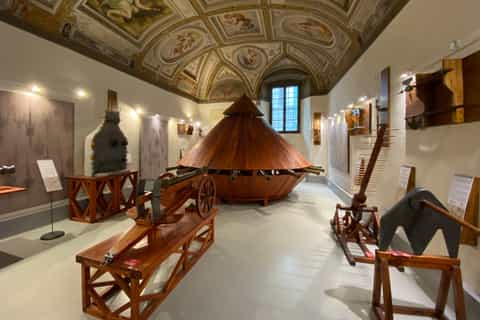
Models linked to protection, stored energy and movement present Leonardo’s military studies as mechanical problems. They should not be read as modern weapons displays.
What to noticeAsk where energy is stored, then look for the part that releases it.
0620+ years ago–2026
Geometry became hands-on learning
The educational laboratory added another route into the same ideas. Visitors can explore self-supporting structures and geometry through practical construction activities.
What remainsBalance and compression become easier to see when separate pieces hold one another in place.
072026–ongoing
The museum remains an active interpretation
The displays continue to ask visitors to compare drawing, reconstruction and use. Their value lies in showing how an idea changes when material, friction and scale enter the picture.
Look closelyA model can expose limits as well as possibilities. That is part of its historical value.